This page contains recent events the team has participated in and summaries of every season of the club since its start during the 2006-2007 FRC season.
- 2020–2021 Season Summary
The 2020-2021 year, despite being all online, still started strong. Our team was able to connect and work together on robotics through Google Meet. We added a new subteam to our leadership structure, the Competition subteam, to help our team keep track of all the awards possible at competition to further our efficiency. We further organized the Communications and Engineering sides of the team by adapting different focuses for them. For example, instead of building the robot this year, Engineering has been largely focused on Computer Aided Design. For our Communications sub team, a change in leadership was implemented to help utilize skills to best fit the circumstances of the pandemic. The club has received a smaller wave of recruits in its online setting. It was harder to receive more recruits due to the pandemic.
Even while being restricted to an all-online environment, our team has been very successful in reaching out to the community. The Imagery subteam has set up a podcast and connected with other FRC teams, the Bellevue Alliance, and even Kevin Ross. It releases biweekly to online platforms. Our team also modified our traditional SERC summer camp to an online SOLE, Saints Online Learning Experience. Members taught elementary school students the foundations of programming through Scratch in this two-week camp. SOLE was one example of how we still maintained connections with students in our school district. The team has also maintained connections with local businesses in the area by starting early on their letter-writing campaign. We attended the Game Design Challenge and got the Concept Award. At the competition, we received the Regional Chairman’s Award and FIRST Dean’s List Finalist Award. Our robot was named R2Tree2.
- 2019–2020 Season Summary
The 2019-2020 year was eventful for Saints Robotics because we had one of the biggest teams in club history, with a new leadership, incoming members, as well as the returning members from previous years. Because we had access to the same location for our club from last year, we didn’t need to prepare a new space, allowing us to get an early head start in the season.
We have been hosting outreach events in elementary schools about once a month, with an overarching goal to get young elementary schoolers excited in STEAM ideologies and techniques. Alongside this endeavor, we also planned many fundraising events to raise money. In this fashion, we also aimed to give back to the wonderful community who helped us be who we are today. The robot cart and T-Shirt Cannon are two examples of projects that we have continued to work on and perfect, and we have used both in our outreach events as engaging models to connect with our audiences.
Additionally, our proximity to school allowed us to better connect with our school. We managed to recruit more members from our school through outreach and also strengthened our relations with the school public through interactive activities such as launching T-Shirts into the crowd during school assemblies (using our T-Shirt cannon) and providing everyone with a heavily discounted breakfast at AppleBee’s.
Saints Robotics also participated in Peak performance and was on the winning alliance at the Girls Generation competition! We were looking forward to the competitions but only had the opportunity to attend Glacier Peak with R2Tree2 before the COVID pandemic started.
- 2016-2017 Season Summary
The team started the 2016-2017 season implementing a training system to help keep all of its members entertained and learning, solving one of the biggest issues from the previous year. Building on the groundwork laid the year before, the club continued its active role in hosting FLL Eastside Qualifiers and attending science fairs across the district, helping to inspire kids at these events to pursue STEM in the future. The team continued its tradition of hosting a summer camp called SERC (Saints Engineering Robotics Camp).
When the six weeks of build season came around, the team was prepared, focusing on finishing with as much time to practice as possible, which showed in the district competitions. The team went to the Glacier Peak and Auburn Mountainview FRC District Events and managed to do well each time, winning the Imagery Award and the Engineering Design Award at the second competition. The robot’s name itself was Woodie Fliers, in honor of Woodie Flowers, one of the heads of the FIRST Program. The 2016-2017 season left the team with high hopes for the future.
- 2015-2016 Season Summary
The 2015-2016 season saw a completely new leadership team composed mostly of juniors. Even with a lack of experience, the season started off strong, with our team making it to the elimination rounds at Girls Generation with the past season’s robot and a record breaking membership of over 100. This created additional challenges for the additional leadership team, especially in keeping all the members involved during the six week build season. The team competed at Glacier Peak and Auburn Mountainview High Schools’ district competitions with our robot, Bamboozler.
The team took on a new challenge, hosting two rounds of the FLL Eastside Qualifiers, with many members being involved, and were able to host over 60 teams. The team also visited many science fairs, bringing the robot and groups of students to promote STEM programs in Bellevue Schools. With all these new experiences, by the end of the season, the team really grew into a cohesive family unit, which can hopefully continue into the future.
- 2014-2015 Season Summary
During the 2014-2015 season, Saints Robotics went to competitions at Glacier Peak High School and Auburn High School. During the off season, freshmen were noticeably more involved in learning and applying new skills, culminating in the construction of a tee-shirt cannon which came in useful for subsequent demonstrations at elementary schools, assemblies, and even the Seafair. Though faced with difficulties such as losing funding from several sources, the graduation of several important members, and the loss of a former mentor’s laser cutter and a Boeing mentor, the team pulled through and built a robot to answer that year’s unique challenge, Recycle Rush.
Aptly named Treecycle, the robot performed clumsily during the first competition, but the loss of its arms lead to increased effectiveness and an amazing comeback in the 2nd round. Although not making it to district finals, the team nevertheless won an entrepreneurship award for its outstanding business plan which detailed how each subteam worked together to spread passion in science and technology, as well as setting goals to achieve in the coming years. By fulfilling and exceeding these objectives, Saints Robotics will continue to grow as a team and spread opportunities in STEM while building increasingly competitive robots. As a result, each and every member is looking forward to another season of enjoyment and enrichment.
- 2013-2014 Season Summary
In the 2013-2014 FRC season, the Saints Robotics team went to the FRC competitions at Shorewood and Glacier Peak High School. The team finished in the quarterfinals at Shorewood and the semifinals at Glacier Peak. The team’s outstanding management lead to them winning the entrepreneurship award as a recognition of the team’s framework for a comprehensive business plan to scope, manage, and achieve team objectives. Although the team did not go as far as they did in the previous season, the team still finished strong and will stay strong in anticipation for the 2014-2015 season.
- 2012-2013 Season Summary
This season the Saints Robotics team participated in the 2012–2013 FRC season, again traveling to both the Seattle and Spokane Regionals, as well as the FRC World Championships in St. Louis. At Seattle, the team made eliminations, but lost in the quarterfinals, whereas in Spokane the team ended up as finalists, receiving an invitation to Championships through the wild card system. At Championships, the team didn’t make eliminations, but maintained a 4-4 record. The team also won the Entrepreneurship Award at Seattle, given to the team with the best business plan for future sustainability, and the Motorola Quality Award in Spokane, given to the team that best exemplifies a quality FIRST team. The 2013 year was one of our best seasons yet, finishing 4th seed in Seattle and 5th seed in Spokane. Our fast and agile robot put up quite the competition at the regional competitions we attended.
This year’s overhaul of design and build for the entire robot greatly revolutionized the way we construct robots. Instead of a conventional metal chassis, the team elected to expand the usage of laser cut wood, testing out and implementing various wooden solutions. As a result, the completely wood chassis turned many heads at all 3 competitions we went to, attracting a lot of attention at the Championships.
- 2011-2012 Season Summary
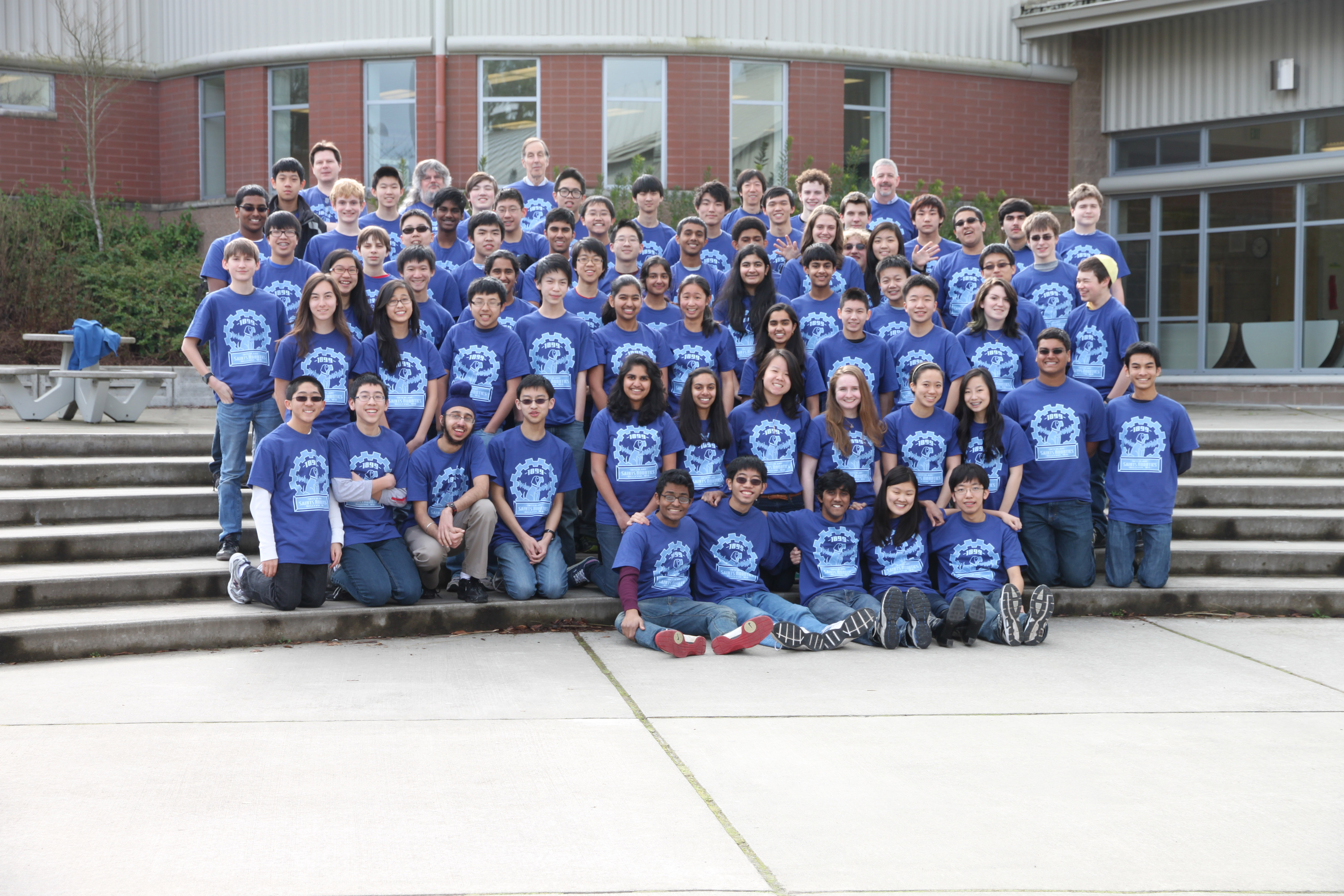
In the 2011-12 season the Saints Robotics team participated in the 2011–2012 FRC season, this time traveling to both the Seattle Olympic and Spokane Regionals. At Seattle, the team made eliminations and ended as a semifinalists, whereas in Spokane the team ended up as quarter finalists. The team also won the Entrepreneurship Award at Spokane, given to the team with the best business plan for future sustainability. Although the robot was not as successful as the breakthrough 2011 season, many lessons were learned from the problems from faulty mechanisms.This year represented a shift in the design and build processes for the team, as the team learned a lot about what structures and mechanisms worked well, and what did not perform to expectations. This would serve us well in the next season. 2012 also was the first year the team integrated laser cut wood elements onto the robot, shaping the materials used in the next year and beyond
- 2010–2011 Season Summary

This year, the Saints Robotics team participated in the 2010–2011 FRC season. At the 2011 Seattle Olympic Regional, we were part of the winning alliance in the elimination matches along with team 2990 and team 3393. We also won the regional Chairman’s Award, given to the team that best represents the values of FIRST. We advanced to the FRC Championships for the first time in the history of the team, where we placed 38th in the Archimedes Division.In addition, we have experienced a great change in leadership this season. Several of our most experienced club members have become officers, including Larry L. (Treasurer), Vivek P. (Build Team Officer), Bobby P. (Build Team Officer), and Tyler O. (Media Officer). Our first VEX competition took place on November 20, 2010 at Redmond High School.
- 2009–2010 Season Summary

Though we started the 2009-2010 season with only five students, we’ve since grown into a vibrant club with over 40 members. Right after the 2009 season our team underwent momentous changes, including reorganization of the leadership team, as well as changes in how the public relations and programming team was run. For the off-season project, the team decided to build a simple second robot for the programming team to work on, as well as modify the “Om-bot” to make it presentable. We also started a Support-Group mostly run by parents in order to help with the organization of carpooling as well as food and chaperoning. In the beginning of the year, the VEX team won at the VEX Jumpstart Competition and qualified to go to the Worlds competition in Dallas, Texas.During build season, the team decided to try a new process for designing the robot, in which the team was split into four sub-teams and each team came up with different ideas for a robot. Through this process, the team was able to come up with many diverse robot designs. Once the team decided on a design, drawing and CAD drawings were made. The team split into the previously determined subteams and started working in parallel on the robot. The final robot uses mecanum wheels, has a powerful kicker, and an arm to lift the robot onto a pullup bar.
- 2008–2009 Season Summary

The 2008–2009 season started with the construction of our off-season project: a robot with four omni-wheels. This was an experimental design with a completely new drive train for our club. 2008 was also the inaugural year for the VEX Robotics team, which competed in the Elevation challenge. The hands-on learning “classes” set up before build season attracted a whole new wave of dedicated members, eager to learn from the veterans. While the build team practiced building, the public relations team hosted multiple events. Interlake High School was the site of the preseason workshop in November, which was attended by about 1000 students from local teams. The kickoff in January, once again hosted in our school, was a tremendous success. Saints Robotics participated in the FIRST Robotics Lunacy Competition with their robot, nicknamed “Om-bot,” and attended the Microsoft Seattle Regional in Key Arena on March 26-28. - 2007–2008 Season Summary

The 2007–2008 season of Saints Robotics was a long adventure. The year started off with a flurry of pre-season planning and activity. Team membership boomed to 43, the website was redesigned, and the team has acquired the support of the Bezos Family Foundation again as well as two new partners: Magellan Architects and Case Engineering. The design division planned an updated drive system even before the kickoff event. Saints Robotics participated in the brand-new Microsoft Seattle Regional in Tacoma with the robot codenamed “Boten Anna” and was able to compete in the finals and bring back home the Second Place Alliance trophy! A huge thanks to all our sponsors, Bezos Family Foundation, Magellan Architects and CASE Engineering without whom we would not have been able to succeed. - 2006–2007 Season Summary

The 2006–2007 season was led by an entirely new leadership that had little to no previous experience on the competition. Despite the rocky start, the robot “Ultimate Novice” was created. Team 1899 was able to enter the Pacific Northwest Regional again due to a grant from the Bezos Family Foundation. Even though the robot was mostly built of parts from the kit, team 1899 finished in 27th place in the Portland Regional. - 2005–2006 Season Summary
Saints Robotics was started in the 2005-2006 season by David Ayele with help from advisory and teacher James Cooney. They attended the Pacific Northwest Regional in Portland, Oregon with the NASA grant for rookie FRC teams. The team competed in that year’s game, Aim High, with their robot, “Nubcake.” While Saints Robotics lacked experience with building robots in the short six-week-long build season, Ayele and his four teammates attended the competition, placing 35th for their rookie year.


 Interlake Saints Robotics